
Master Your Emotions
Master your emotions, or they master you.

Weakness + Introspection = Progress.Chapter 18, The Big Bold Mindset®
How do you manage your emotions under pressure?
Look inward, not just outward. Notice the emotional home you go to under pressure, such as ego, blame or feeling like a victim, and write down the patterns that repeat. Ask people you trust for your single biggest weakness, then sit with it and watch your responses change.
Ego. Blame. Victim.
It took me years to face my own patterns. Ego: I'm right and you're wrong. Blame: it's your fault, not mine. Victim: things are being done to me and I'm helpless.
The victim pattern stayed hidden the longest. All three were set early in life and played out for far too long.
Staring at those weaknesses was painful. The reward came when I could see a situation play out and not react the way I once did.
What's your emotional home under pressure?
When the pressure's on, what's your default response?
Grab a pen. What patterns do you see repeating?
What would the people who know you best say?
You find what you look for.
Look around you now and count everything that's red. Take 30 seconds. Done? Now, how many green things did you see? When we tell our brains to look for something, we find it. Patterns are the same.
Look inward, not just outward
Grit isn't enough
Setting your face against the wind closes down time to reflect, so patterns repeat.
Patterns show under pressure
How we do anything is how we do everything.
Leaders go first
When leaders face their own emotions, they create safer teams.
Jeff Weiner: vulnerability and emotional awareness
Weiner talked openly about stress and well-being, and shared personal stories with his teams. By being open about his own challenges, he made it safer for others.
He's one of a growing number of leaders who see that how we lead has to evolve.
None of us are the finished article.Caspar Craven
The WIP formula
Work in Progress: Weakness + Introspection = Progress. Three steps, and the middle one is the hardest.
Find the pattern
Note your repeating patterns. Then ask people you trust: what's my single biggest weakness? Write it down. Don't argue.
Sit with it
Caspar wrote BLAME on a sheet of paper and stuck it on his bathroom mirror. Keep it front of mind.
Notice the change
Watch your responses under pressure. Note when you choose differently. Keep going.
Ask one honest question
Ask one person you trust: what's the single biggest thing holding me back? Write down exactly what they say. Don't argue. Thank them, then sit with it for a week.
Patterns in the team
Teams have patterns too. Name them without blame and you can change them.
Run this with Caspar in the room
The 20-minute version above works on its own. With Caspar in the room it goes further: he brings the stories behind Master Your Emotions, then takes your team through the exercise live, so everyone leaves with an experiment they have chosen themselves.
- Creator of The Big Bold Mindset®
- Leadership keynote speaker: events in over 38 countries, for over 400 organisations going through change
- 2x round the world sailor
- Former CFO (multiple exits) and an Associate Director at KPMG
“Hager Group invited Caspar to talk to 500 people about resilience and how to adapt in times of crisis. I wish I could’ve heard him talk all day.”
Caspar has worked with organisations including BAE Systems, Burberry, GSK, Intuit, INEOS Styrolution, Johnson & Johnson, Nuffield Health, Pearson, Sage, Suntory and Thales.
Questions about Master Your Emotions
What is the WIP formula?
WIP stands for Work in Progress: Weakness + Introspection = Progress. First identify your weaknesses by reflecting on repeating patterns and asking trusted people for feedback. Then sit with what you learn. Then notice and note when you make different choices under pressure.
Why do leaders need to engage with their emotions?
Harvard’s Linda Hill surveyed 1,500 executives in 2022. The top skills they said they needed were adaptability, curiosity, creativity and comfort with ambiguity, all of which mean sitting with uncertainty. Leaders who embrace their own emotions are more likely to create psychological safety.
Is mental toughness enough to handle pressure?
Caspar believes not on its own. Grit has its place, but toughing it out closes down time for introspection and can create less resilient cultures. In 2022, 38 FTSE 350 CEOs stood down, up from 18 in 2021.
- WIP formula
- Caspar’s Work in Progress formula, Weakness + Introspection = Progress: identify your weaknesses, sit with them, then track how your responses change.
- Emotional home
- The default emotional pattern you go to under pressure, shaped by your life experiences. Caspar’s own were ego, blame and victim.
More from Caspar on this
Short reads that take this principle further, with the stories behind it.
The Cost of Pretending You’re Fine
When was the last time you asked someone if they were ok, and you got back “I’m fine”? On hearing those words, you knew that “I’m fine ” was the last…
Read the piece →August 2021I'm fine
I’m fine Easiest two words any of us can say. They trip off the tongue. It’s such a British thing isn’t it. Few people want to draw attention to…
Read the piece →February 2024The Biochemistry of Feelings
Yesterday, I was in the audience listening to the brilliant Professor Nick Lane, Professor of Evolutionary Biochemistry at UCL. The topic: “What is a…
Read the piece →For how to prepare a whole team for setbacks, see how to build team resilience, from the book Be More Human.
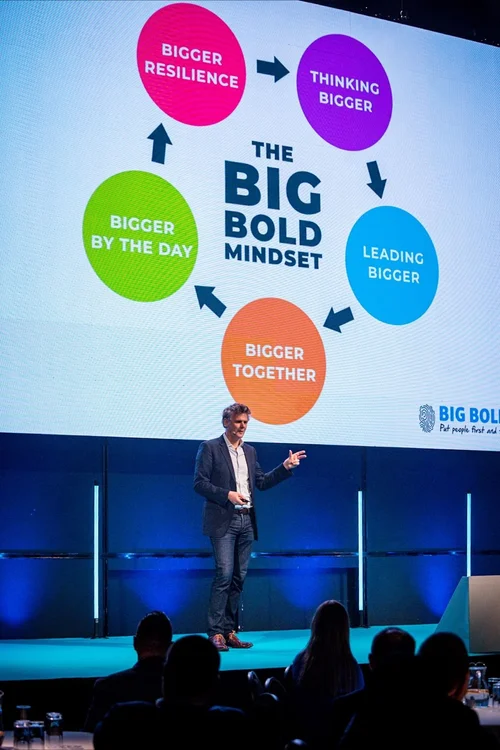
This is Chapter 18 of The Big Bold Mindset®
The full chapter has the whole story, the research and more leaders who lived it.
Rated 5.0 out of 5 by readers on Amazon.